
Why Early Detection Changes the Outcome
The single biggest factor in a positive outcome is timing. When melanoma is caught and it is still localised to the skin, the five-year survival rate is about 99 per cent. Once it spreads to nearby lymph nodes, that number drops to roughly 76 per cent. It falls further to about 35 per cent if it reaches distant organs. The earlier a suspicious spot is evaluated, the simpler and more effective treatment tends to be.
Delays matter in very concrete terms. Research on melanoma patients found that those treated 30 to 59 days after biopsy had a meaningfully higher risk of dying from the disease than those treated within 30 days. The risk climbed even further for patients who waited more than four months. Dermatologists and ENT/facial surgery specialists alike recommend acting on suspicious changes promptly.
The Early Signs of Skin Cancer
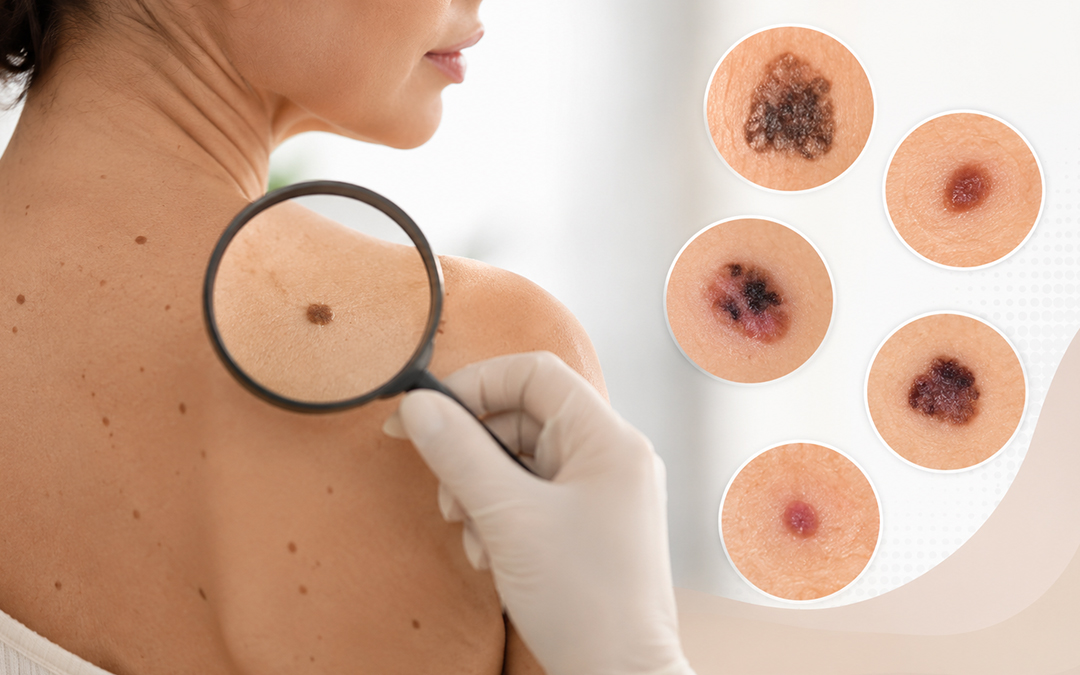
Early-stage skin cancer does not always look dramatic. A person can see a new mole, a mole that is changing, a rough patch, or a sore that will not heal. Early lesions are often subtle. So they are frequently mistaken for eczema, a bug bite, an age spot, or simple dry skin. Below are the patterns worth paying attention to.
The ABCDE Rule for Moles
The ABCDE rule remains the standard framework for evaluating a mole for melanoma:
- Asymmetry — one half of the mole does not match the other half.
- Border — the edges are irregular, blurred, or notched rather than smooth.
- Colour — the mole contains more than one shade or unusual colours, such as red, white, or blue.
- Diameter — the spot is larger than about 6 millimetres, roughly the size of a pencil eraser.
- Evolving — the mole is changing in size, shape, colour, or sensation over time.
The “Ugly Duckling” Sign
Providers also look for the “ugly duckling” sign: a spot that simply looks different from everything else on a person’s skin. A brand-new lesion on previously clear skin, or one mole that stands out from the rest, is a pattern worth having examined, even if it does not meet every ABCDE criterion.
Sores, Bumps, and Patches
Not every skin cancer starts as a mole. Basal cell and squamous cell carcinomas, the two most common forms of skin cancer, often appear as a firm red bump, or a sore that bleeds, a shiny or pearly bump, a persistent pink or red scaly patch, crusts, heals, and then reopens in the same spot. A sore that lingers for more than three weeks without healing is considered a warning sign and should be evaluated.
Itching, Bleeding, and Pain
Skin cancer symptoms are not limited to appearance. A mole or spot that suddenly starts itching, becomes tender, or bleeds without any injury should not be dismissed. Basal cell carcinoma can feel like a firm bump, squamous cell carcinoma can feel rough or scaly, and melanoma, while usually painless, can itch or bleed as it progresses.
Colourless or Amelanotic Melanoma
Most people associate melanoma with a dark or black mole, but a less common form called amelanotic melanoma produces little or no pigment. These spots can appear pink, red, or nearly the colour of the surrounding skin, which makes them easy to overlook. Because they lack the classic dark colouring, amelanotic melanomas are sometimes diagnosed later. It makes regular self-checks especially important.
Basal Cell, Squamous Cell, and Melanoma at a Glance
The table below summarises the most important differences between the three main types of skin cancer.
| Feature | Basal Cell Carcinoma | Squamous Cell Carcinoma | Melanoma |
| Typical appearance | Pearly or waxy bump; pink/red scaly patch; sore that won’t heal | Firm red or skin-colored bump; scaly patch; open sore that bleeds | New or changing mole; irregular shape and color |
| Common locations | Face, ears, scalp, neck | Face, ears, lips, back of hands | Anywhere on the body, including non-sun-exposed skin |
| Sensation | Usually painless; may crust or bleed | May be tender, scaly, or rough | Usually painless; may itch or bleed as it evolves |
| Typical first-line treatment | Excision, Mohs surgery, cryotherapy | Excision, Mohs surgery, radiation | Surgical removal; immunotherapy for advanced stages |
| Outlook when caught early | Highly curable | Highly curable | Very high survival, but risk rises quickly if it spreads |
Melanoma Survival Rates by Stage
This table shows why early detection makes such a dramatic difference in outcomes.
| Melanoma Stage at Detection | What It Means | 5-Year Survival Rate |
| Localized (early stage) | Cancer is confined to the original spot on the skin | About 99% |
| Regional | Cancer has spread to nearby lymph nodes | About 76% |
| Distant (metastatic) | Cancer has spread to distant organs | About 35% |
How to Perform a Skin Self-Exam
Perform the check in a well-lit room, ideally after a shower, using a full-length mirror and a hand mirror for hard-to-see areas.
- Face, ears, neck, and scalp, including under the hairline.
- Chest, abdomen, and underarms.
- Arms, hands, palms, and between the fingers.
- Back and buttocks, using a hand mirror or asking a partner for help.
- Legs, feet, soles, and between the toes.
Get familiar with your moles, freckles, and marks so that any new or changing spot stands out. Taking dated photos of any borderline spots makes it easier to track changes over time.
When to See a Doctor
Any new, changing, or unusual spot deserves a professional opinion, especially if it persists for more than two to three weeks, bleeds, itches, or looks different from the rest of your skin. One of the most common reasons early skin cancer is caught late is waiting to “see if it goes away.” A same-week evaluation is reasonable for any lesion that is bleeding, rapidly growing, or painful.
Skin Cancer Treatment Options
Most basal cell and squamous cell carcinomas, along with early-stage melanomas, An in-office procedure successfully treats most basal cell and squamous cell carcinomas, as well as early-stage melanomas. successfully with an in-office procedure. Standard excision removes the growth along with a margin of healthy tissue. Mohs micrographic surgery removes the cancer one thin layer at a time. It examines each layer under a microscope until no cancer cells remain, offering a very high cure rate with minimal scarring. Cryotherapy and electrosurgery are additional options for smaller, early lesions. For more advanced melanoma, treatment may include immunotherapy, targeted drug therapy, or radiation, guided by a specialist based on the type, size, and stage of the cancer.
The Bottom Line
Skin cancer is common, but it is also one of the most treatable cancers when caught early. Get to know the early signs of skin cancer, check your skin monthly, and schedule a professional evaluation for any new or changing spot. It can protect your health. If you have noticed a spot that concerns you, don’t wait for it to change further. Schedule an evaluation with our care team today.
Recent Comments